
4. Issues of Ethnopharmacology in HIV Management
Two Types of HIV
HIV-1 and HIV-2 are 2 distinct types of human immunodeficiency virus. However, both of them share the same modes of transmission—sexual contact, blood exposure, and vertical (ie, mother to child), and both seem to be associated with the same clinical manifestations. HIV-2, however, appears to be more difficult to transmit, and the time between acute infection and the appearance of clinical manifestations is longer. Globally, HIV-1 is by far the more common of the 2 types, whereas HIV-2 is seldom found outside West Africa.
HIV-1 Groups
HIV-1 infection is further categorized in 4 groups (Figure 1):
- Group M, the major group
- Group O, a much less common outlier group
- 2 newer groups, N and P
Figure 1. HIV types, groups, and clades
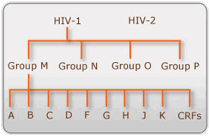
Group O infections seem to be confined to West-Central Africa, and group N infections, discovered in 1998 in Cameroon, is extremely rare. In 2009 a new strain discovered in a Cameroonian woman was designated HIV-1 group P.[Plantier 2009] Nevertheless, group M infections account for > 90% of HIV-1 infections globally. Within group M are ≥ 9 genetically distinct subtypes (known as clades): A, B, C, D, F, G, H, J, and K. [WHO Immunization 2003]
In addition, viruses from 2 different clades that have both infected the same cell in an individual can exchange genetic material to give rise to a hybrid strain.[Burke 1997] Although hybrid strains generally do not survive long, those that infect more than one person are known as circulating recombinant forms (CRFs). For example, the CRF A/B is a mixture of viruses from clades A and B.