
5. Culturally Competent Care for Substance Users Diagnosed with HIV Disease
Substance Use as a Risk Factor for HIV Infection
Currently, the main drivers of the HIV epidemic in the United States are:
- The approximately 20% of HIV-infected individuals who are not aware of their HIV status [CDC HIV Prevalence Estimates, 2006]
- Substance use, with its related increase in risky sexual activity and sharing of drug injection equipment.
Since the beginning of the HIV epidemic in 1981, injection drug use has directly and indirectly accounted for more than one-third (36%) of AIDS cases in the United States. Of the 42,156 new cases of AIDS reported in 2000, 11,635 (28%) were IDU-associated. Since the beginning of the epidemic, a larger proportion of AIDS cases are associated with IDU (including drug use itself and sex with partners who inject drugs) among adolescent and adult women vs men (57% vs 31%, respectively). Figure 1 shows the extent to which injection drug users contribute to the ongoing epidemic beyond just the substance users themselves. [CDC Drug-associated HIV Transmission 2007]
Figure 1. Proportion of IDU-associated AIDS cases, by exposure category, reported in 2000 (see below)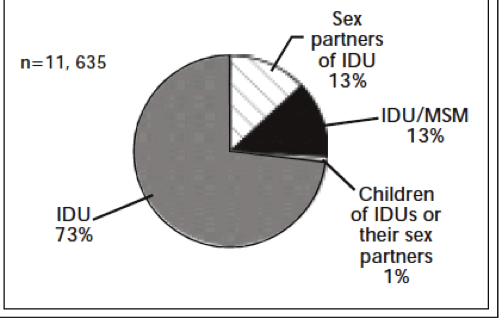
Non-injection drugs (such as cocaine and methamphetamines) also contribute to ongoing HIV transmission when users exchange sexual activity for drugs or money or engage in risky sexual behaviors
that they might not engage in when sober. For example,
a CDC study of > 2,000 young adults in 3 urban neighborhoods found that crack smokers were 3 times more likely to be HIV-positive than nonsmokers. A recent analysis by Hall and colleagues reported that an estimated 49% of new HIV transmissions were from persons who were not aware that they are HIV-infected. This reality underlies the 2006 CDC recommendation that screening for HIV infection should be incorporated into routine medical care. [CDC Revised recommendations] (See the curriculum, “Promoting HIV Testing in Diverse Populations.”